




















Supreme I-177 B Tube Testers Hickok 6000A

Mutual Conductance Tube Testers
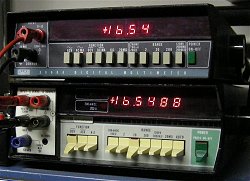
I use a Hickok 6000A tube tester (above right) to test most newer tubes (12AX7A, 6X4, etc.). It has a roll chart listing settings for
most tubes it tests and I also have additional data for testing obsolete and foreign tubes.
 |
 |
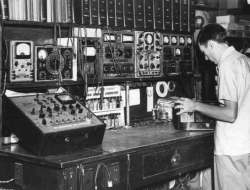
My Supreme I-177 B tube tester (above left) is used to test most older radio vacuum tubes including antique 4 and 5 pin tubes
(01A, 83, etc.). The I-177 series testers were well built, military testers which utilized the Hickok circuits. They were produced by several manufactures for
the military including Hickok and Supreme Instruments. My I-177 B was manufactured by Supreme around 1950 and has a booklet with the tube settings in the cover.
My Supreme Collection
|
You will also see a Triplett 2413 tube tester on the bench that I use for non-critical "quick checks" like shorts and open/close checks on eye
tubes. This reduces the wear and tear on my more expensive tube testers. Test data for all my tube testers
is also stored and searchable on the workbench computer to speed up finding tube settings and reduce the
wear and tear on the testers paper roll charts and booklets.
|
|
Many older radios and some radio test equipment were wired with a "Hot" chassis. An upper workbench AC outlet is isolated from the main AC power through a 500VA isolation transformer.
This helps protect me from shocks when working on old radios. The variable AC supply (VARIAC) lets me bring the voltage up slowly in older equipment when I first power it up to help
limit damage to the circuits if an old component fails.
Voltage and current meters on the variable AC supply allow me to monitor the power draw as the line voltage is brought up. A light bulb is also kept in series in the AC supply line to act as a ballast.
If a radio starts to draw too much current as the voltage is increased, the amp meter reading on the supply will increase and the ballast light bulb will start to glow and let me know there is a problem.
I use a clear glass 100w light bulb so I can easily see any change in the filament's glow.
If you don't have a variac, you can bring voltage up in steps using a "Dim Bulb Tester" that you can construct for just a few dollars with some light bulbs, a cord, and an AC socket.
Some equipment I build myself (not kits).
This audio generator helps test amplifier circuits and sound equipment.
It produces sign, triangle, and square waves with adjustable audio frequency and amplitude.
|
I built the breadboard above to test transistor and digital circuits and to
temporarily replace components in low voltage circuits under repair. It has a fixed 5V power
supply, an adjustable +/- DC supply, a pulse generator, LEDs for monitoring digital circuit status,
plenty of switches and I/O connectors for jumpers, and a Digital Volt Meter.
This simple "Lamp Test Jig" which I made with several different style lamp
sockets and connectors for meters and power supplies, saves me a
lot of time testing lamps. I can easily test filaments and current draw on bulbs and
fuse lamps without using a mess of jumpers and alligator clips.
|

GE #81 Fuse Lamp under current test
|
 |
 |
This tool kit keeps all my hand tools organized. The Xcelite TC-100 tool kit originally came in a
briefcase. I had an Anvil road case custom made for it that is deep enough under the tool pallet to store larger items,
meters, and testers. Its held up well despite several years on the road when
I was a pro sound engineer. I think that if the house was burning and I could only grab one thing
from my antique radio collection or workbench, this would be it.
|

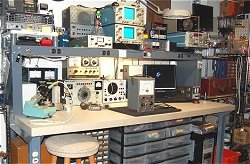
I've been asked why my repair bench looks so neat and clean.
All I can say is when I need something, I don't like looking all over for it. Just ask the kids...
My repair bench computer contains files of updated tube testing data for all my tube testers along with thousands of radio and test
equipment schematics, parts lists, and dial string diagrams. Internet access comes in handy when I have to
search for additional information or manuals I don't already have.
|

One of my networked workstations
|
|
The web site work is done on separate computers but all
computers are networked for sharing files of equipment data and for Internet access.
 |
Several thousand vacuum tubes are kept for rebuilding
radios and vintage test equipment. Once tubes are tested,
they are stored in my tube cabinet (an old auto parts cabinet) or in one
of my Radio/TV repairman's tube caddies.
|
I keep an extensive library of antique radio service books, and thousands
of original antique radio schematics covering the 1920's, 30's, 40's and 50's.
My collection includes schematics and
service notes published by Gernsback, Rider, Beitman, early Howard W. Sams, and service information and diagrams from manufactures such as Crosley, RCA Victor,
Motorola, Philco, GE, Zenith and others. I also have vacuum tube manuals, tube substitution books, and cross reference manuals for finding information
such as tubes cross referenced by manufacture, model, number of tubes and type for help in identifying unmarked radios.
|
All radio cabinet repair, refinishing, and any chassis metal work
is done out in the workshop.
A 12" drill press, belt and disk sander, scroll saw, and band saw are my most used power tools.
Sawdust, striping chemicals, and drill bit shavings don't mix well with electronics and test equipment
so I keep them far away from each other. |
 |
Antique radio collecting can be a fun hobby. Even if you start out with
just a screwdriver and an old desk in the basement, getting that old radio working you found
at a garage sale or auction is a very rewarding experience.
For other antique radio resources visit my antique radio links site:
AntiqueAirwaves.com
Thanks for stopping by.
|